
Residential Epoxy Flooring
Residential Epoxy Flooring in Meredith for homeowners facing stained garage floors, damp basement surfaces, or worn workshop areas
Winni Epoxy LLC installs residential epoxy flooring across Meredith and surrounding New Hampshire communities, creating seamless surfaces that resist stains, chemicals, moisture, and the kind of everyday wear that comes from vehicles, stored equipment, and household activity. Homeowners turn to epoxy when concrete has absorbed oil, developed surface pitting, or when they need a floor that tolerates both winter salt and summer humidity without breaking down. The coating bonds directly to prepared concrete, forming a nonporous barrier that stops contaminants from penetrating and makes routine cleaning a matter of sweeping and occasional mopping rather than scrubbing embedded grime.
Epoxy flooring works for garages, basements, workshops, and living spaces because the resin system cures into a hard, impact-resistant surface that handles dropped tools, rolling toolboxes, and consistent foot traffic without chipping or wearing through. Surface preparation is the foundation of adhesion—grinding removes laitance, opens the concrete pore structure, and creates the mechanical bond that keeps the epoxy in place under thermal expansion and contraction cycles common to New Hampshire's temperature swings.
Schedule a property evaluation to review your concrete condition and discuss color and finish options that suit your space.
What Proper Installation Requires

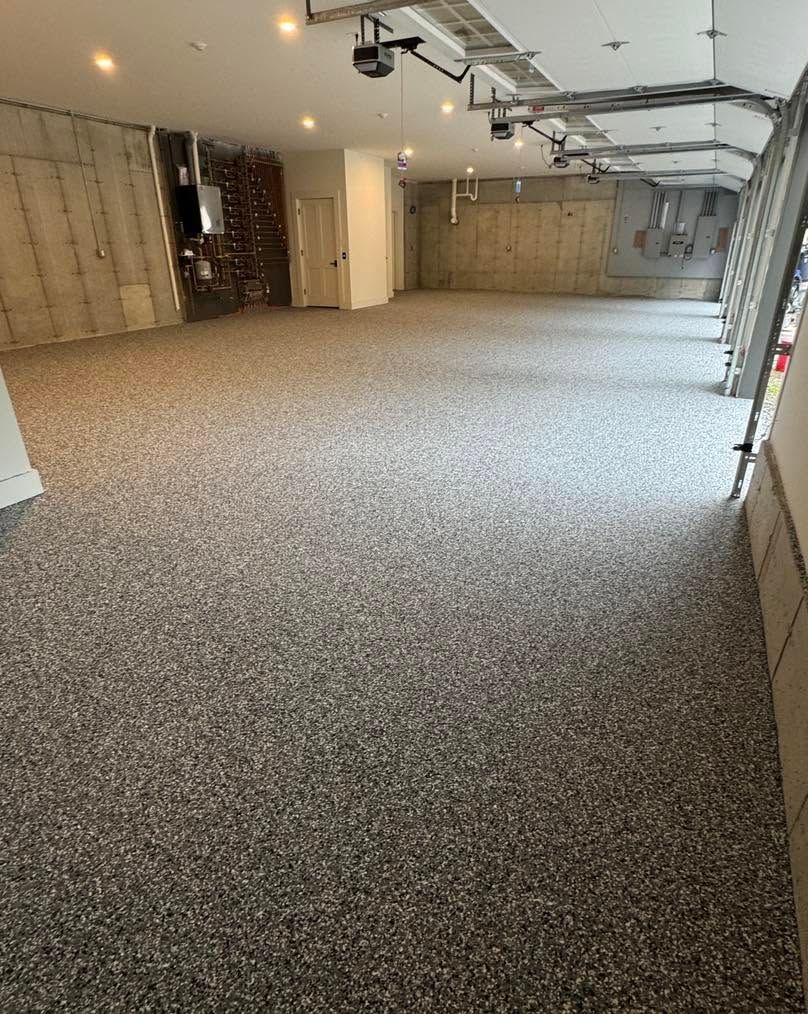
Installation begins with mechanical surface preparation using diamond grinding equipment to remove any existing coatings, sealers, or surface contaminants that would interfere with adhesion. The concrete is profiled to a specific roughness, then vacuumed clean so the epoxy resin can penetrate and lock into the substrate. Once the base coat is applied, decorative flakes or quartz can be broadcast into the wet epoxy to add texture, color variation, and slip resistance, followed by a clear topcoat that seals everything into a unified system.
After curing, you'll notice the floor no longer absorbs spills—liquids bead on the surface and wipe away without leaving stains. The seamless finish eliminates the grout lines and porous texture that trap dirt in traditional flooring, so dust and debris stay on the surface where they're easy to remove. The coating reflects overhead lighting, which brightens spaces like basements and garages that previously felt dim due to the light-absorbing quality of raw concrete.
Color and finish options range from solid neutrals to multi-tone flake blends, with gloss levels from satin to high-gloss depending on whether the space prioritizes subtle refinement or maximum light reflection. The system is built in layers, so if the floor ever needs refreshing years down the line, a new topcoat can be applied over the existing epoxy without removing the base layer, provided the surface remains well-bonded and undamaged.
What Homeowners Ask About Epoxy
Residential epoxy flooring questions often focus on durability under specific conditions, preparation requirements, and how the finished surface performs in New Hampshire's climate, where freeze-thaw cycles and moisture infiltration are routine concerns for concrete slabs.
What makes epoxy different from paint or sealers?
Epoxy is a two-part resin system that chemically cures into a rigid, bonded layer rather than sitting on top of the concrete like paint, which is why it resists peeling and handles impacts that would crack or chip a topical coating.
How does surface preparation affect the outcome?
Grinding removes the weak surface layer of concrete and opens the pores so the epoxy can anchor into the substrate, which is what prevents delamination when the slab expands and contracts with seasonal temperature changes common in Meredith and surrounding areas.
Why do some epoxy floors wear faster than others?
Thickness and topcoat quality determine abrasion resistance—industrial-grade urethane topcoats handle significantly more traffic than standard epoxy topcoats, which matters in high-use garages or workshop spaces.
What happens if moisture is present in the slab?
A moisture test is conducted before installation because excessive vapor transmission from below can push the epoxy off the surface, especially in basements where groundwater pressure is higher.
How long before the floor can handle vehicle traffic?
Full chemical cure typically takes several days, during which the surface hardens to its final strength and chemical resistance, so early loading can leave tire marks or surface impressions in the still-curing resin.
Winni Epoxy LLC provides detailed estimates that include surface preparation, material specifications, and finish options tailored to how you use your space. Request a free estimate to explore a residential flooring solution designed for your specific concrete condition and performance needs.